
Making a home on the moon
Making a home on the moon
Johann-Dietrich Woerner, the new director general of the European Space Agency (ESA), believes that humans should plan to live on the moon. According to Woerner, it’s time to picture a world of human existence beyond earth.
A village on the moon may soon be a possibility. In fact, Julian Spector from City Lab even outlines a blueprint of what homes in space could look like.
Housing
Researchers have discovered hundreds of steep-walled pits on the moon that could provide shelter and protection from meteoroids, solar radiation, and drastic temperature shifts. NASA’s Lunar Reconnaissance Orbiter spotted pits that range in size from 5 to more than 900 meters in diameter. Some pits appear to widen underground, suggesting that some of these holes might lead to caves, which provides further protection from hazardous environmental risks.
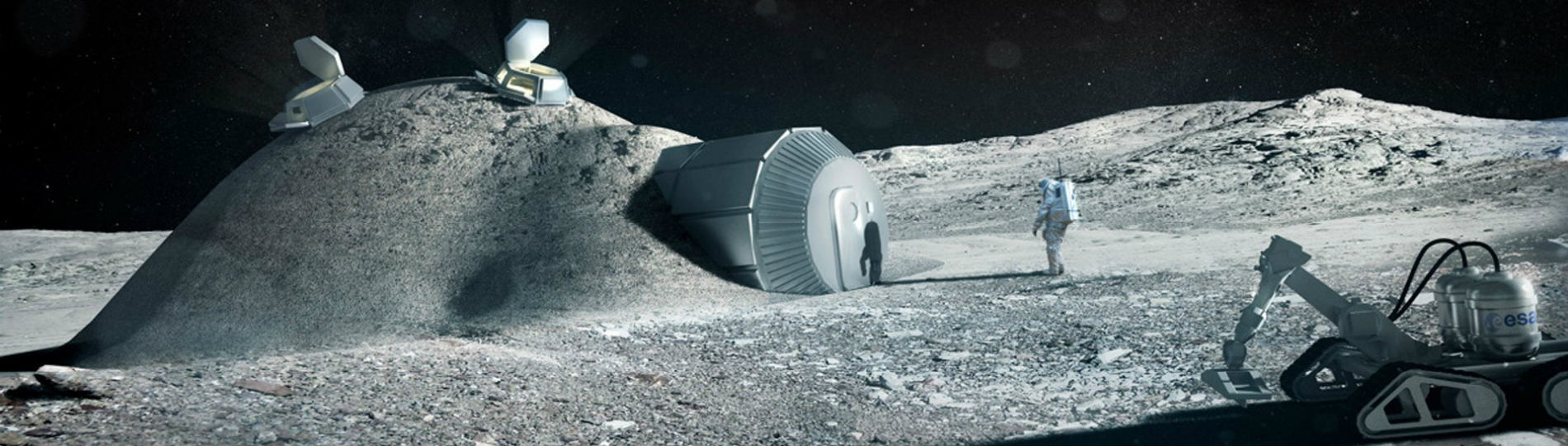
Woerner says the moon’s soil can serve as insulation for housing; however, another adhesive needs to be developed to bind the soil into a “moon concrete.” He also predicts that housing preparation will be carried out from Earth, where robots will build housing on the moon before humans arrive to finish the job.
Scott Hovland of ESA’s human spaceflight team points out that 3D printing, “Offers a potential means of facilitating lunar settlement with reduced logistics from Earth.” Homes will be printed using lunar soil mixed with magnesium oxide and a binding salt that converts the lunar material to a form of cement. By creating homes shaped into domes with cellular-structured walls and pressurized inflatables, houses on the moon will be resilient against extreme climates.
Although both food and water can be flown in from Earth, it’s possible for a human colony to survive on lunar farming. A report last year indicates that 20 percent of crops grown in lunar soil survived for 50 days. Another study titled “Can Plants Grow on Mars and the Moon: A Growth Experiment on Mars and Moon Soil Simulants” reports that “plants are able to germinate and grow on both Martian and moon soil simulant … without any addition of nutrients.”
Lunar soil has low acidity and is unable to hold water, which poses questions about whether it’s even safe to consume food grown in extraterrestrial soils. Even assuming that plants and crops that are safe to eat can grow in outer space, where will the water come from to water our food with and how will irrigation be possible? There are two possibilities: ship water from Earth or mine water from the moon.
In the summer of 2008, water was conclusively discovered when an Apollo 15 mission brought back lunar volcanic glasses. Later, NASA’s Moon Mineralogy Mapper on the Indian Space Research Organization’s Chandrayaan-1 spacecraft captured images of water-rich minerals around a small crater on the moon. More than 40 craters, ranging from 1 to 9 miles in diameter, were found with water ice for a total of at least 600 million metric tons of water ice.

